

What Documents Do You Need to Get Married in Ireland?
One of the most common questions couples ask when planning their wedding is:
What documents do I need to get married in Ireland?
If you’re getting married in Ireland — whether it’s a church, civil, spiritual or humanist ceremony — there are specific legal requirements you must meet before your wedding day.
The most important document of all?
Your Marriage Registration Form (MRF) — often referred to by couples as the “green folder.”
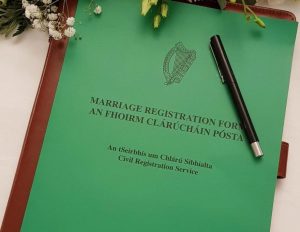
Without this, you legally cannot get married.
This wedding blog explains exactly what you need, when to apply, and how the process works.
What Documents Do You Need to Get Married in Ireland?
To legally marry in Ireland, couples must:
-
Give at least 3 months’ notice to a Registrar
-
Attend an in-person appointment
-
Provide specific documentation
-
Receive a Marriage Registration Form (MRF)
Let’s break it down step by step.
How Do You Give Notice of Intention to Marry in Ireland?
Regardless of your ceremony type (church, civil, or humanist), you must book an appointment to give your Notification of Intention to Marry.
This appointment must take place at least 3 months before your wedding day.
Appointments are booked online via the Civil Registration Service.
Both partners must attend the appointment in person.
⚠️ Important: Book early. Appointment availability can be limited, especially during peak wedding season.
What Documents Are Required for the Marriage Notification Appointment?
You will need to bring the following documents:
Required Documents
-
Photo ID (passport or driving licence) for both partners
-
Original birth certificates (both partners)
-
PPS numbers (both partners)
-
Proof of address (e.g. utility bill for each person)
-
Names and dates of birth of your two witnesses (must be over 18)
-
Divorce papers (if previously married)
-
Death certificate (if widowed)
It is always advisable to confirm directly with the Registrar when booking your appointment in case additional documentation is required.
What Information Must Be Confirmed Before the Appointment?
Before attending your appointment, you must have confirmation of:
-
The date of your wedding ceremony
-
The location of your ceremony
-
The name of your solemniser
-
Confirmation that your solemniser is registered in Ireland
Your solemniser must be listed on the official Register of Solemnisers.
How Much Does It Cost to Get Married in Ireland?
There is a €200 notification fee payable at your appointment.
If you are having a civil ceremony conducted by the Registrar, there may be an additional ceremony fee. Your local office will advise you of this.
What Is the Marriage Registration Form (MRF)?
After your appointment, and once the Registrar is satisfied that you are free to marry, you will receive your Marriage Registration Form (MRF).
This document:
-
Must be brought to your wedding ceremony
-
Is signed by both partners
-
Is signed by your two witnesses
-
Is signed by your solemniser
This signing takes place during the legal part of your ceremony.
Without the MRF, your marriage cannot be legally registered.
What Happens After the Wedding Ceremony?
Once signed, the MRF must be returned to the Registrar within one month of your wedding day.
Because this is a tight timeframe, many couples ask a trusted family member or friend to return it on their behalf if they are heading off on honeymoon.
Your marriage is only legally registered once the signed MRF has been received and processed.
FAQs About Getting Married in Ireland
Q: How far in advance do you need to give notice to get married in Ireland?
A: At least 3 months before your wedding date.
Q: Do both partners have to attend the Registrar appointment?
A: Yes, both parties must attend in person.
Q: Can you get married without the Marriage Registration Form?
A: No. The MRF is legally required for your marriage to be registered.
Q: Who can be a witness at an Irish wedding?
A: Anyone over 18 years old.
Q: What if I was previously married?
A: You must bring official divorce papers or a death certificate if widowed.
Planning a wedding involves more than just venues and dresses — the legal side matters too.
If you’d like more practical wedding planning advice, checklists and real guidance for brides in Ireland, explore my blog or take a look at My Wedding Planner, where I break everything down step-by-step.
Happy Planning 💍






What a wonderfully clear and helpful guide! I’m absolutely delighted by how comprehensively you cover all the required documents and steps for marrying in Ireland. A warm welcome to your brilliant approach—thank you for sharing such invaluable insight!
Thanks so much Dean! I really appreciate your comment as it can be so confusing for couples planning their wedding
Excellent info. Thank you so much. I was just wondering if you can organise the appointment if you havnt yet got a solemniser yet?
Hi Aoife, I would say yes you can book your appointment now before having a solemniser but you would need to have one confirmed by the date of your appointment. Many, thanks, May